What is an autonomous vehicle hub?
Autonomous mobility is often described in terms of the cars themselves. But every robotaxi that picks up a passenger has spent the previous night somewhere — being charged, washed, calibrated, diagnosed, and queued for service. That somewhere is an autonomous vehicle hub. Without it, the fleet stops.
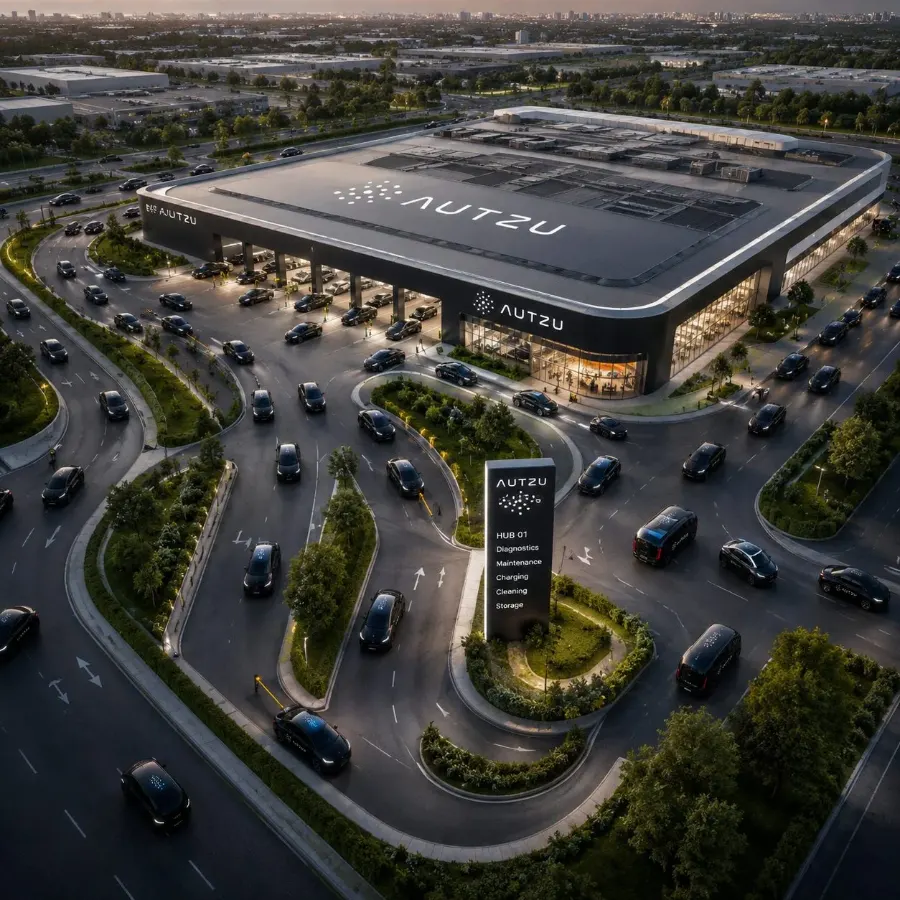
A working definition
An autonomous vehicle hub is a purpose-built facility where a fleet of self-driving vehicles is stored, energised, cleaned, inspected, calibrated, repaired, and dispatched. It sits at the intersection of three things that did not need to be co-located before: an EV charging plaza, an automated service centre, and a software-driven dispatch operation.
A hub is not a parking lot with chargers. It is the operational chassis of the fleet — the place where the cost of a robotaxi mile is actually decided.
Why hubs exist at all
Three forces converge to make the AV hub necessary:
- Sensor calibration. Every autonomous vehicle relies on a stack of cameras, LiDAR, radar, and inertial sensors that drift out of spec with use. Recalibration on the side of the road is not viable; it needs a controlled environment with reference targets and known geometry.
- Energy throughput. A 250-vehicle robotaxi fleet running 18 hours a day pulls megawatts of grid power at predictable peaks. That requires utility-scale switchgear, on-site batteries, and software to schedule charging without tripping demand charges.
- No driver in the loop. There is no human to refuel, clean a spill, replace a wiper, or notice a cracked sensor cover. Every task that a driver used to handle ad-hoc now has to be designed into a workflow at a facility.
What an AV hub actually contains
A real hub bundles four physical zones with a software layer over the top:
- Charging plaza — 150 to 350 kW DC fast chargers, with load-balancing software that decides which vehicle gets electrons next based on dispatch demand, not first-come-first-served.
- Service bays — robotic cleaning, automated inspection, predictive diagnostics, tire and brake service, sensor cover replacement, and software updates. These run 24/7 and turn vehicles around in single-digit minutes.
- Calibration lanes — controlled lighting, painted reference targets, turntables, and dynamometer rigs that verify the sensor stack and the AV compute end-to-end before a vehicle is released to the road.
- Staging and dispatch — short-stay positions where ready-to-dispatch vehicles wait for the next rider. Dispatch logic is driven by software, not by a yard manager with a clipboard.
On top of all of that sits the operating system — fleet state, energy state, asset health, alarms, partner integrations — that any of this is worth.
How a hub is different from things people compare it to
- A gas station serves humans buying fuel by the gallon. A hub serves a software dispatcher buying kilowatt-hours at the rate the fleet needs them.
- A traditional taxi depot is mostly parking. A hub is mostly machines.
- An EV charging station ends at the cable. A hub starts at the cable.
- A dealership service centre is reactive — vehicles arrive broken. A hub is predictive — vehicles are diagnosed before they break.
Where this is heading
Public AV programs from Waymo, Cruise, and Aurora show that the rate-limiting step of the next decade is not the autonomy stack — it is the operational footprint underneath it. Hubs are the operational footprint. The operators that scale will be the ones that treat the hub as a product, not as real estate.
That is the thesis Autzu is built on. Our Giga Hubs already serve rideshare drivers operating Tesla Model 3s today, and the same physical pattern is what will serve autonomous fleets tomorrow. The transition is mostly software, partnerships, and process — not concrete.
References & further reading
- Waymo — How Waymo operates and services its fleetwaymo.com/journey
- IEEE / SAE — Best practices for autonomous vehicle sensor calibrationsae.org
- McKinsey & Company — The road to autonomous vehiclesmckinsey.com
- BloombergNEF — Electric Vehicle Outlook 2025bnef.com
