From rideshare EVs to autonomous fleets: Autzu's growth path
The strongest startups have a wedge that earns revenue today, an adjacency that earns revenue tomorrow, and an endgame that compounds for a decade. Autzu's path runs cleanly through all three: rideshare EV rental as the wedge, autonomous fleet infrastructure as the adjacency, and the default operating layer of autonomous mobility as the endgame.
Stage 1 — The rideshare-EV wedge (today)
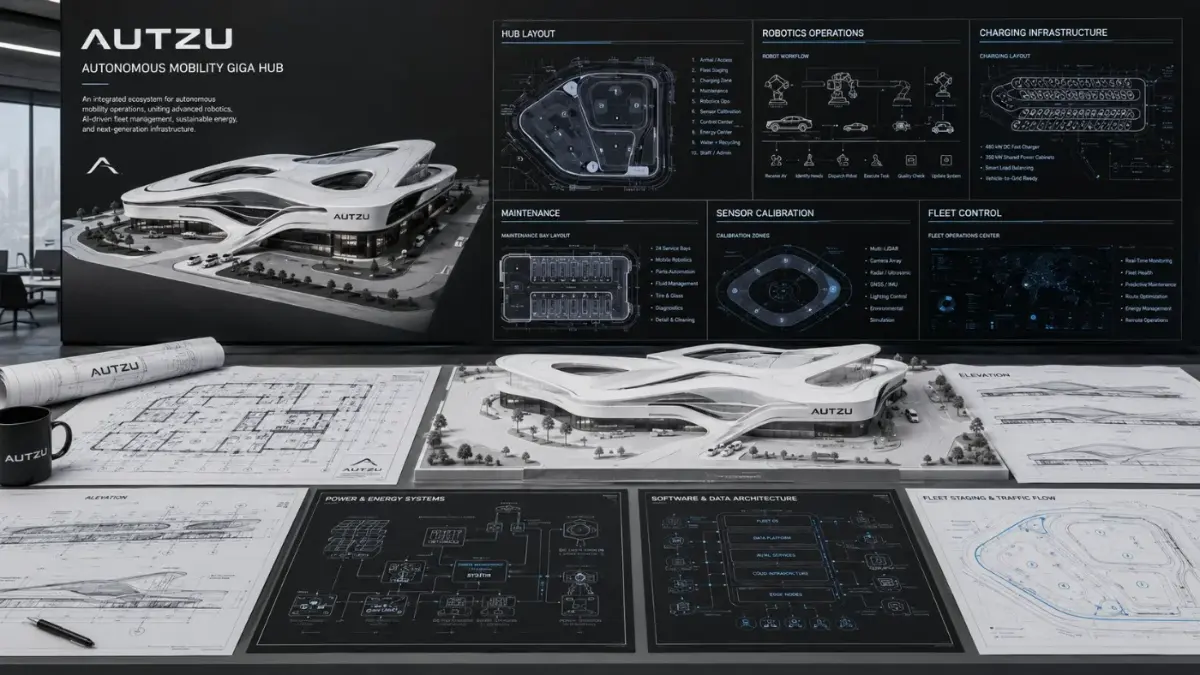
Today, Autzu operates Giga Hubs that serve rideshare drivers renting Tesla Model 3s. The wedge is real: revenue, paying customers, established unit economics, growing fleet. This is not a deck-only business.
Why this is the right wedge:
- It builds the exact physical and software infrastructure that the autonomous endgame requires. Every hub built for rideshare drivers today is a hub that serves autonomous operators tomorrow without re-tooling.
- It funds compounding learning. Every operational learning — charger handoff time, energy curves, hub layouts, software primitives — transfers directly to autonomous operations.
- It establishes the regulatory and utility relationships in each market years before autonomous operations begin.
In strategic terms, the rideshare-EV business is the option premium on autonomy: revenue-positive today, while the option compounds.
Stage 2 — The autonomous adjacency (next 24–48 months)
AV operators today are individually building or commissioning their own depots, charging plazas, calibration facilities, and operations software. That is a billion-dollar duplication of effort across the half-dozen operators racing to commercial deployment.
Autzu's wedge converts to the adjacency as soon as one AV operator chooses to outsource the operational layer. Once that happens, the cost-of-operation comparison forces every other operator to evaluate the same decision. The economics of shared infrastructure crush owned infrastructure at scale — exactly as they did in cloud, payments, and data.
Three triggers accelerate this conversion: a new market entry (where a greenfield operator chooses outsourced infrastructure to move faster), a fleet-size threshold (above ~500 vehicles, owned infrastructure becomes uneconomic), and a public quarter where one operator's outsourced cost-per-mile beats another's by a margin too large to ignore.
Stage 3 — The default operating layer (5–10 years)
The endgame is not "Autzu serves all the AV operators." The endgame is "running an autonomous fleet without Autzu is uneconomic in the markets Autzu serves." This is the same shape as AWS in cloud, Stripe in payments, Cloudflare in delivery, Snowflake in data warehousing.
At that point the platform compounds in three ways:
- Operator switching cost — once an AV operator runs on Autzu infrastructure, the cost to migrate is measured in vehicle-months of lost revenue, not engineering hours.
- Network effects on demand — multi-operator infrastructure means every hub can serve every operator's vehicles. Utilisation rises non-linearly with operator count.
- Data effects on margin — the cost per mile of running on the Autzu platform falls every quarter as the platform learns. Switching off it gets harder, not easier.
Why this sequence is repeatable, not lucky
Every infrastructure winner of the past three decades has followed roughly the same three-stage path: a wedge that earns revenue in a smaller adjacent market, an adjacency that converts as the bigger market matures, and an endgame that compounds for a decade. Autzu is built deliberately around this pattern, not adjacent to it.
The rideshare-EV wedge already works. The autonomous adjacency already has named customers in pilot. The endgame is the standard infrastructure-layer trajectory of the past three decades. Investing in Autzu today is investing in the same shape that built AWS, Stripe, and Cloudflare — applied to a category that is structurally similar and three years ahead of the inflection.
References & further reading
- Sequoia Capital — The wedge thesissequoiacap.com
- a16z — Why infrastructure compoundsa16z.com
- AWS — From book retailer adjacency to default cloud (re:Invent history)aws.amazon.com
- Stripe — How payments infrastructure compounds (founder essays)stripe.com/atlas
