The TAM under autonomous mobility infrastructure
Public TAM estimates for autonomous mobility focus almost entirely on the ride. The ride is the wrong unit. The unit that determines who captures the durable value is the vehicle-year of operational infrastructure underneath every fleet. Sized properly, it is a $100B+ annual market by the early 2030s — and a real, revenue-generating one today.
Why the ride is the wrong unit
Most public AV TAM estimates start with "trips per year × revenue per trip." That number gets to $1T+ at maturity, which is correct but unhelpful. It tells you about the application layer. It says nothing about who actually captures durable margin in the stack underneath.
The right unit is the vehicle-year of operational infrastructure: every autonomous vehicle in service needs to be charged, cleaned, calibrated, diagnosed, serviced, dispatched, energy-managed, and supported every day of the year. That spend is the infrastructure-layer revenue opportunity, and it is far more concentrated than the trip revenue is.
Sizing the autonomous-fleet infrastructure spend
Working from public analyst projections (RethinkX, BloombergNEF, McKinsey):
- Global autonomous fleet by 2030: 1.5–2.5M vehicles in operational service across North America, Europe, and East Asia.
- Operational infrastructure cost per vehicle-year (charging plaza, cleaning, calibration, hub real estate amortisation, software platform, energy management, maintenance, support): $35,000–$70,000 fully loaded depending on geography and fleet density.
- Steady-state addressable market at the infrastructure layer: $50B–$175B per year, with the midpoint around $100B.
That is the infrastructure layer alone, excluding the cost of the vehicles themselves, the autonomy stack, and the trip-level economics. It is roughly three to five times the size of the global commercial real estate fleet-yard market today.
The pre-autonomous TAM is also real
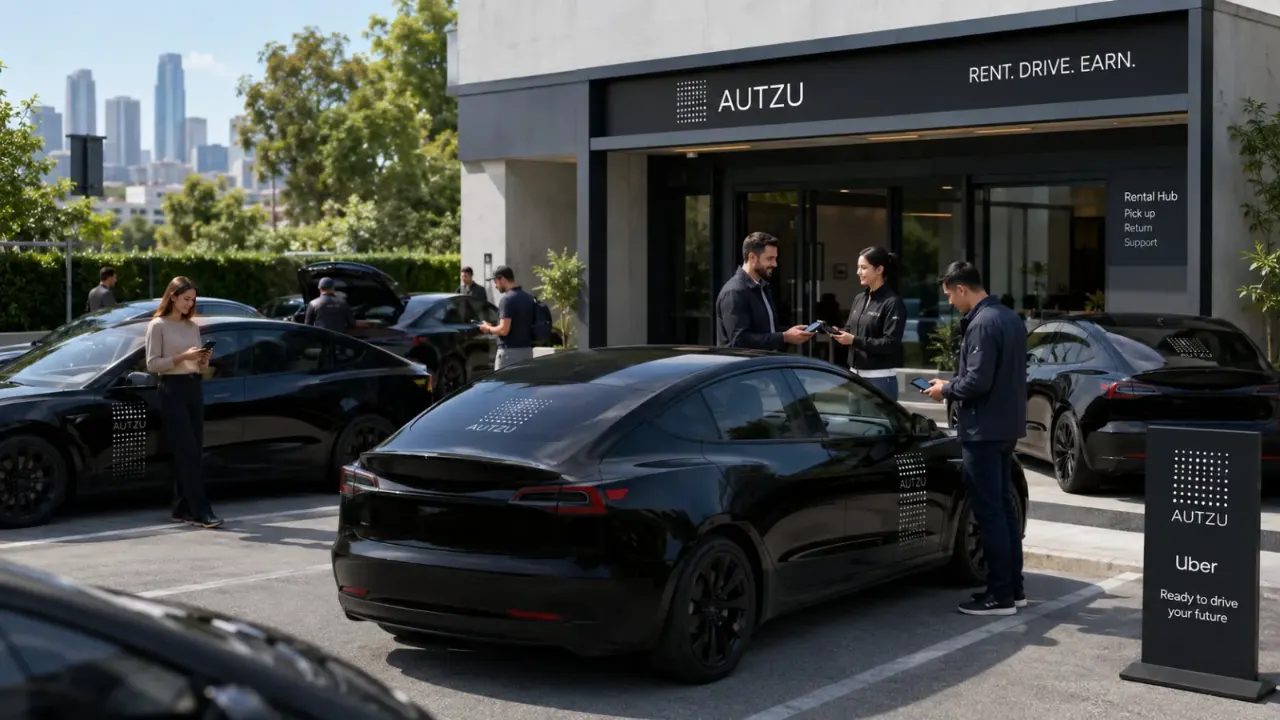
A common objection to infrastructure-layer investing in AV is "we have to wait for autonomy." Autzu does not. The same physical hub footprint that will serve autonomous fleets in the late 2020s already serves rideshare EV drivers today.
- ~4M active rideshare drivers across North America (Uber + Lyft).
- Uber's public commitment to 100% EV on its platform by 2040 in the US/Canada/Europe.
- Approximately 35% of those drivers do not own a vehicle suited to rideshare and rent one — a $12B+ annual rental TAM today, growing into the EV transition.
This is the market Autzu monetises today. Every hub that serves rideshare drivers in 2026 is the same hub that serves autonomous operators in 2029. Capital does not have to wait for autonomy to begin compounding.
Where adjacent expansion lands
Three adjacent markets become accessible from the hub footprint with minimal additional capex:
- Commercial EV fleets — last-mile delivery, municipal fleets, contractor vehicles. Charging plaza utilisation outside rideshare peak hours.
- Energy resale — V2G (vehicle-to-grid) services and arbitraging on-site battery capacity to utilities. Becomes meaningful at >50-vehicle hubs.
- AV operator services — sensor calibration as a service for AV development fleets, before any operator commits to full hub operations.
The honest answer on timing
There is genuine timing risk on the autonomous side. If commercial AV deployment slips three years, the infrastructure TAM at the autonomous layer slips with it. But because the pre-autonomous market is real today, the investment is not binary. Even on the most pessimistic AV timeline, Autzu compounds through the rideshare-EV layer until autonomy arrives.
On the most optimistic AV timeline, the infrastructure layer becomes the bottleneck of the entire industry, and Autzu is the only neutral, multi-operator player positioned to clear it.
References & further reading
- RethinkX — Rethinking Transportation 2020–2030rethinkx.com
- BloombergNEF — Electric Vehicle Outlook 2025bnef.com
- McKinsey & Company — Mobility's second great inflection pointmckinsey.com
- Uber Technologies — ESG commitments and 100% EV pledgeuber.com/sustainability
